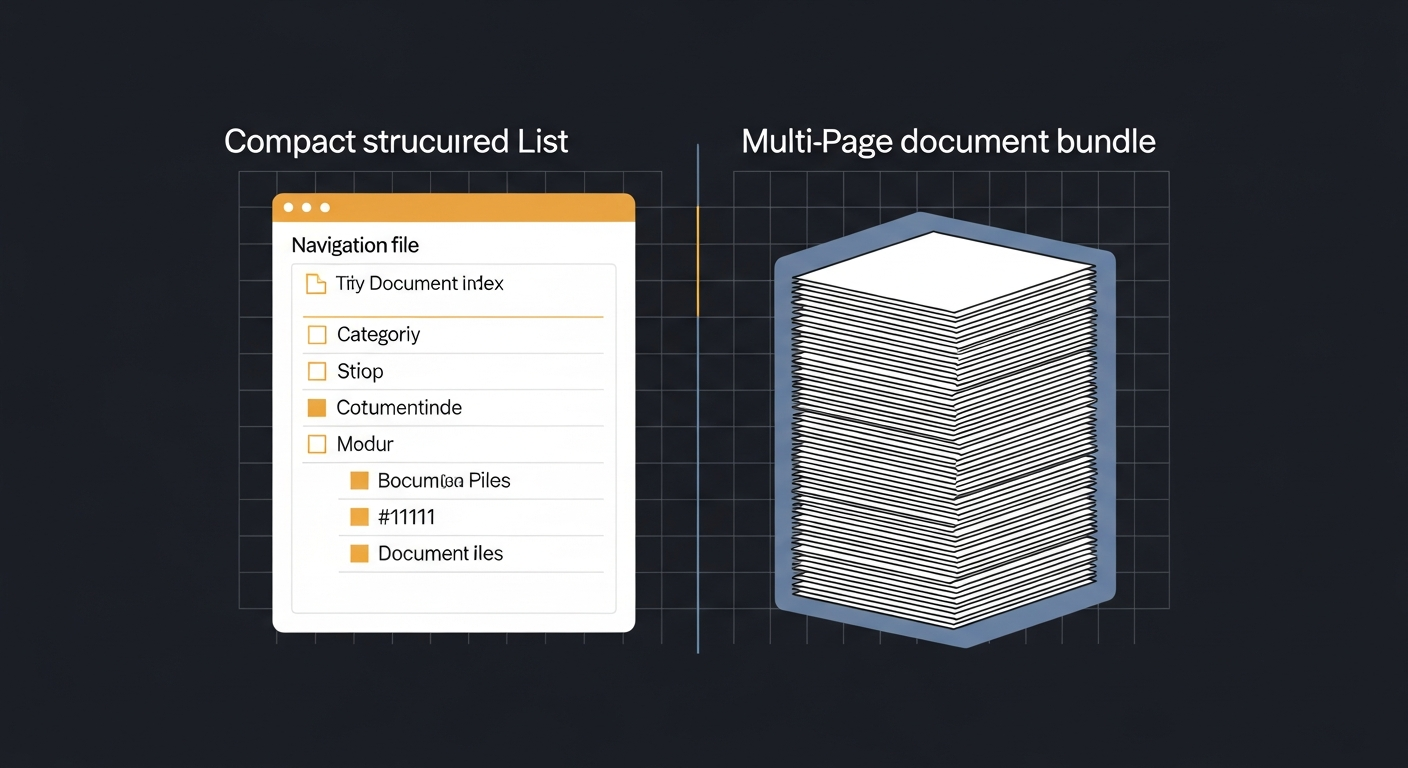
If you've been reading about AI-ready websites, developer docs, or AI visibility, you've probably seen two filenames show up more and more often: llms.txt and llms-full.txt.
They look like a pair. That's exactly what makes them confusing.
A lot of teams assume both are part of one fixed standard. Others assume that publishing both must be better than publishing one. And some are already treating them like SEO shortcuts. That's where things start going wrong. The simple version is this: llms.txt is a curated map of your most important content. llms-full.txt is a broader Markdown export designed to provide much more context in one file. Most websites do not need both. Most should start with llms.txt and only add llms-full.txt when their documentation is deep enough that a compact index is no longer enough. The official llms.txt proposal is centered on /llms.txt, while major docs ecosystems like OpenAI and Claude Code have independently adopted the pattern.
And one more thing up front: if your goal is better visibility in Google Search, these files are not magic. Google's own guidance says you do not need special AI text files or special AI markup to appear in Google's generative search features. The fundamentals still matter most: crawlability, indexing, helpful content, and solid technical SEO. See Google's guide to AI search optimization.
If you want the broader foundation first, start with our complete guide to llms.txt. If you already understand the basics and want a straight answer on whether you need both files, this guide is for you.
The short answer
Here's the cleanest way to think about it.
- llms.txt is the index. It helps models, agents, and external tools understand what your site contains and where to look first.
- llms-full.txt is the expanded companion. It provides a much larger body of content in one Markdown file.
That's the core difference.
If your site is relatively small, mostly marketing pages, or has only a modest documentation footprint, publish llms.txt and stop there.
If you run a large docs portal, API documentation, or a substantial knowledge base, publishing both can make sense.
The right question is not "Can we generate both?" The right question is "Does the second file add useful context without adding unnecessary complexity?"
What is llms.txt?
According to the official llms.txt proposal, llms.txt is a Markdown file published at the root of a website to help language models use that site more effectively at inference time. The proposal describes a simple structure: a title, a short summary, optional explanatory text, and grouped lists of important links. It is designed to be both human-readable and easy for tools to process.
That design choice matters.
A good llms.txt file is not supposed to be a dump of every URL on your site. It is supposed to be a curated overview of what matters most.
That usually includes:
- a clear project or company name
- a short explanation of what the site is
- grouped sections for core pages, docs, policies, resources, or guides
- concise descriptions that explain why each linked page matters
Think of it as a high-signal content map.
That is also why llms.txt works alongside, not instead of, files like robots.txt and sitemap.xml. The proposal itself explains that these files serve different purposes: robots.txt is about access rules, sitemap.xml is about indexable pages for search engines, and llms.txt is about giving language models a curated view of the site. For a deeper comparison, read our guide on robots.txt vs llms.txt.
What is llms-full.txt?
llms-full.txt is usually a much larger Markdown export of your content.
Instead of acting as a map, it acts more like a bundled knowledge file.
This is already visible in real documentation systems. OpenAI's API docs expose a root llms.txt that points to a "Combined API docs" llms-full.txt — a single-file Markdown export of API guides and docs. Claude Code docs also publish a documentation index at /llms.txt and use it explicitly as a way to discover available pages before exploring further.
That does not mean every website should do the same thing.
It means this pattern is genuinely useful in environments where a short index and a deeper single-file export solve two different problems: discovery and depth. For a docs-heavy product, that distinction can be useful. For a content-light marketing site, it is often overkill.
Is llms-full.txt part of the official standard?
This is where many articles get fuzzy.
The public proposal at llmstxt.org is centered on /llms.txt. It explains the purpose of the file, how it should be structured, and how it fits alongside existing web standards. The base proposal itself is about llms.txt as the standard entry point.
So the most accurate way to say it is this:
- llms.txt is the public proposal
- llms-full.txt is an emerging implementation pattern used by some documentation ecosystems and AI vendors
That wording matters. If you describe llms-full.txt as a universally ratified part of the standard, technical readers will notice the overstatement immediately. The stronger move is to be precise.
llms.txt vs llms-full.txt: the practical difference
The easiest way to compare these files is by job, not by file name.
llms.txt is for discovery
Its job is to tell a model or agent what your site is, what matters most, and where to look first. A good llms.txt stays selective. It points to high-signal pages: product pages, docs, onboarding guides, pricing, policies, and resources.
llms-full.txt is for depth
Its job is to expose much more of the actual content in one place, so tools can ingest a broader body of information without jumping between many pages.
That makes it useful for:
- API documentation
- reference docs
- large help centers
- technical manuals
- deep product documentation
- complex knowledge bases
The real tradeoff is simplicity vs completeness
A compact file is easier to maintain, easier to review, and easier to keep clean. A fuller file can be more useful in the right setup, but it is also easier to let it become stale, noisy, or bloated. That is why more is not automatically better.
When llms.txt is enough
For most websites, llms.txt is enough.
That includes:
- small B2B SaaS websites
- startup marketing sites
- agencies and service businesses
- company websites
- portfolios
- sites with a limited docs or help footprint
If your site has a handful of pages that already explain who you are, what you do, how pricing works, and where the main resources live, a curated index usually solves the main problem. In that situation, adding llms-full.txt often adds process overhead without adding much real value.
A better investment is often:
- making your core pages clearer
- improving internal linking
- tightening product and documentation structure
- publishing a clean llms.txt
For practical ideas on that, read 5 practical ways to improve your site visibility for LLMs.
When llms-full.txt makes sense
llms-full.txt becomes much more compelling when your site has real documentation depth.
That usually means:
- a large API docs portal
- a product with many setup and integration guides
- a broad help center
- a deep technical documentation library
- a developer platform with lots of interconnected reference material
This is the context where a full Markdown export becomes genuinely useful. If an assistant or coding agent benefits from loading a much larger documentation bundle in one fetch, then llms-full.txt can be a practical operational format. That is why you see the pattern in major technical docs ecosystems like OpenAI's. It is not a signal that every site should publish one — it is a signal that docs-heavy sites may benefit from it.
Do you need both?
Usually, no. That is the honest answer.
Most websites should start with one question: Would a compact index already solve the real problem? If the answer is yes, publish llms.txt first.
Add llms-full.txt only if:
- your content depth is high enough to justify it
- a single-file export would genuinely help tools or agents
- your docs can be exported cleanly
- your team can keep the file current
That last point matters more than people think. A full file that is stale, incomplete, or inconsistent is not a trust signal. It is just another artifact to maintain. Start lean, and add depth only when depth is actually useful.
Will these files help you rank in Google?
Not directly.
If your goal is Google visibility, the safest move is to align with what Google actually says, not with vague AI SEO claims.
Google's official guide to optimizing for generative AI features in Search says you do not need special files like LLMS.txt, special markup, or separate AI-only optimization tactics to appear in generative AI search experiences. Google's broader SEO Starter Guide still points people back to the same foundations: helpful content, crawlability, indexing, site structure, and good technical hygiene.
That does not make llms.txt useless. It just means you should think of these files as content understanding and content delivery layers, not as ranking hacks. If your SEO fundamentals are weak, llms.txt will not save you. If your structure is strong, llms.txt can make that structure easier for external tools to understand.
Best setup by website type
| Website Type | Recommendation |
|---|---|
| Small business website | llms.txt only |
| B2B SaaS marketing site | Usually llms.txt only |
| SaaS with a growing docs section | Start with llms.txt; add llms-full.txt if docs become substantial |
| API-first developer platform | Both often make sense |
| Large help center or knowledge base | Both can make sense |
| Ecommerce site | Start with llms.txt; full companion only if strong educational content exists |
| Content-light startup | llms.txt only — discipline wins here |
Common mistakes to avoid
- Treating llms-full.txt as mandatory — it is not
- Turning llms.txt into a sitemap clone — the point is curation, not exhaustiveness
- Publishing both files without a reason — if the second file does not clearly improve context, it is probably unnecessary
- Making claims you cannot support — neither file replaces technical SEO, and Google is explicit that special AI-only files are not required for generative AI visibility
- Letting files go stale — this matters especially for llms-full.txt, where maintenance is ongoing
A better way to think about it
A lot of the confusion around these files comes from treating them like ranking tactics. That is the wrong frame.
A better frame:
- llms.txt helps external systems understand the shape of your site
- llms-full.txt helps them ingest more of your content when a compact index is not enough
Simple sites need structure. Deep documentation sites may need both structure and a fuller export. Everything else is noise.
Generate your llms.txt in seconds
If you already know your site would benefit from a clean, structured llms.txt, you can build it now — free, no account needed.
Generate your llms.txt →Final verdict
If you want the shortest honest answer:
- publish llms.txt first
- publish llms-full.txt only if your content depth justifies it
llms.txt is the map. llms-full.txt is the expanded companion. For most websites, the map is enough. For docs-heavy websites, both can be useful.
And if your primary goal is stronger visibility in Google, do not confuse these files with the fundamentals. Google still rewards the same core things it always has: technically accessible pages, strong internal linking, clear site structure, and genuinely helpful content. See our guide on improving your site's AI visibility for practical steps you can take alongside publishing these files.
FAQs
What is the difference between llms.txt and llms-full.txt?
llms.txt is a compact index of your most important content. llms-full.txt is a broader Markdown export that contains much more of the content itself.
Do I need both llms.txt and llms-full.txt?
Usually not. Most websites should start with llms.txt only. Add llms-full.txt only when your site has enough documentation depth to justify it.
Is llms-full.txt part of the official llms.txt spec?
Not in the same way. llms.txt is the public proposal described at llmstxt.org. llms-full.txt is better understood as an emerging ecosystem pattern used in documentation-heavy environments.
Does llms.txt help with Google rankings?
Not directly. Google's own guidance says special AI-only files are not required for generative AI visibility in Search.
Which sites benefit most from llms-full.txt?
API docs, developer platforms, large help centers, and documentation-heavy products benefit the most, because they have enough depth for a full-text export to be useful.
Tags
About the author
Builds the infrastructure behind LLM.txt Generator. Writes about AI systems, web crawling, and how large language models consume information.
Ready to make your site AI-visible?
Generate your llms.txt file in 10 seconds — free, no account needed.
Get Your llms.txt →